

Chicken Farming in North Africa Trends Challenges and Best Practices for Sustainable Growth
Chicken farming in North Africa sits at the centre of three urgent needs: affordable protein, rural income, and more resilient food systems. From the Nile Delta to the Maghreb, poultry has become one of the most adaptable forms of livestock farming because it needs less land than cattle, can scale from family flocks to commercial units, and meets strong demand from households, restaurants, schools, and food processors.
The sector is growing, but it is not easy. Feed prices shift quickly. Heat stress can cut production. Disease outbreaks can wipe out months of work. Water is scarce in many areas, and small farmers often lack steady access to finance, training, and reliable markets.
The good news is that chicken farming in North Africa has room to grow in a smarter way. Better housing, stronger biosecurity, improved feed planning, local value chains, and farmer support networks can help poultry businesses become more profitable and sustainable.

Poultry demand is rising across North Africa
Poultry has become a preferred source of animal protein for many North African households. Chicken is usually cheaper than red meat, cooks quickly, and fits well into local cuisines, from grilled chicken and tagines to stews, sandwiches, kebabs, and rice dishes.
Urban growth is one of the strongest drivers. As cities expand, demand rises for consistent supplies of eggs and broiler meat. Supermarkets, cold stores, butcheries, quick-service restaurants, hotels, and institutional buyers all need regular volumes. That creates opportunities, but it also pushes farmers to improve quality, timing, and food safety.
Several trends are shaping the industry.
Commercial farms are becoming more organised
The region still has many backyard and smallholder flocks, but commercial poultry production has grown in and around major towns and farming zones. Larger farms often have better housing, vaccination plans, feed contracts, and market links.
This shift does not remove the role of small farmers. In many communities, small poultry units remain vital because they provide eggs, home consumption, and quick cash. The real change is that successful small farms are becoming more planned. Farmers are keeping records, separating age groups, buying better day-old chicks, and working with local vets.
Demand for processed poultry is increasing
Consumers still buy whole birds in many markets, but demand for dressed chicken, portions, marinated cuts, sausages, nuggets, and ready-to-cook products is rising. This is strongest in urban areas, where households value convenience and food safety.
Processing also helps farmers and traders reduce waste. A bird that does not fit the preferred live market size can still enter a processed product. Local slaughter facilities, cold rooms, packing businesses, and transport services can all benefit from this shift.
Feed efficiency is now a top priority
Feed is usually the largest running cost in poultry production. Maize, soya, wheat by-products, minerals, and premixes often depend on imported ingredients or prices linked to global markets. When feed prices rise, profit margins shrink fast.
This has pushed interest in:
Better feed conversion through quality chicks and balanced rations
Local feed ingredients where safe and nutritionally suitable
Feed storage that prevents mould and pests
Phase feeding for broilers and layers
Reducing waste from poor feeders and spillage
The farms that survive difficult price cycles are often the ones that track feed use carefully.
Climate-smart poultry housing is gaining attention
North Africa’s climate varies from humid coastal zones to dry inland and desert areas. Hot weather can reduce feed intake, slow growth, lower egg production, and increase mortality. For that reason, poultry housing is no longer just a shelter. It is a climate management tool.
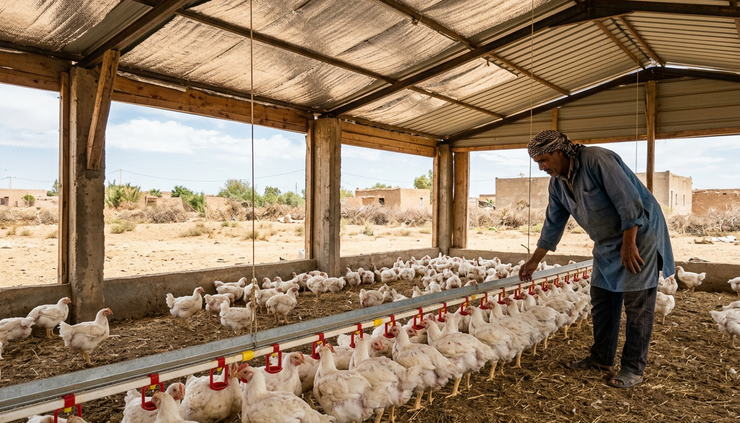
Farmers are paying more attention to ventilation, orientation, roofing materials, insulation, side curtains, evaporative cooling, shade, and access to cool drinking water. Solar energy is also becoming attractive where electricity supply is costly or unreliable.
Sustainability is becoming part of market value
Sustainability in poultry farming is not only about the environment. It also means stable income, local jobs, safer food, and efficient use of water, feed, and energy.
Some farms are finding value in manure management, local sourcing, low-waste feeding, better bird welfare, and reduced antibiotic misuse. These practices can lower costs and build trust with buyers. Over time, farms that can prove consistent quality and responsible production may gain stronger market access.
The main challenges are practical and often linked
Poultry farming can look simple from the outside. Buy chicks, feed them, sell birds or eggs. In practice, the business depends on tight control of many moving parts. A weak link in one area can affect the whole cycle.
Feed costs can make or break the farm
The biggest risk for many poultry farmers is not lack of demand. It is the cost of production. Feed prices can change due to drought, import delays, currency pressure, fuel costs, and competition for grain.
Small farmers often buy feed in small quantities, which can be more expensive. They may also lack storage, so they cannot buy when prices are favourable. Poor-quality feed creates another problem. If a ration is not balanced, birds may eat more but grow slowly or lay fewer eggs.
Good feed planning means more than finding the cheapest bag. It means knowing the bird’s stage, buying from trusted suppliers, checking expiry dates, protecting feed from moisture, and measuring performance.
Heat stress is a constant threat
High temperatures affect almost every part of poultry production. Birds do not sweat. They cool themselves through breathing, behaviour, and contact with cooler air or surfaces. When heat builds up inside poorly ventilated houses, birds eat less, drink more, crowd near openings, and become vulnerable to disease.
Layers may produce fewer eggs with thinner shells. Broilers may take longer to reach market weight. In severe cases, mortality can rise quickly.
Heat stress is often worse when stocking density is too high, water lines are dirty, roofs trap heat, or houses face poor airflow. This makes housing design one of the most important investments in the region.
Disease control needs daily attention
Poultry diseases spread quickly because birds live in groups. Common threats in North Africa include Newcastle disease, infectious bronchitis, Gumboro disease, coccidiosis, fowl pox, salmonella, and avian influenza. Disease risk varies by country, season, farm type, and biosecurity level.
A disease outbreak brings direct losses through mortality, slower growth, poor egg production, treatment costs, and market restrictions. It also affects trust. Buyers prefer farms that can supply healthy birds consistently.
Vaccination helps, but it is not enough on its own. Farmers need clean houses, controlled movement, footbaths, pest control, good litter management, isolation of sick birds, and proper disposal of dead birds.
Water quality is just as important as feed
Water scarcity is a serious issue in many parts of North Africa. Poultry need constant access to clean water, especially in hot weather. If water is salty, contaminated, too warm, or interrupted, production suffers.
Poor water can carry bacteria and minerals that affect health and equipment. Nipple drinkers and tanks also need regular cleaning. A farm can buy excellent feed and chicks, but still perform poorly if water is neglected.
Market access is uneven
Some farmers sell to live bird traders. Others supply slaughterhouses, supermarkets, hotels, or local shops. Each market has different requirements for bird size, timing, health status, packaging, and payment terms.
Small farmers may struggle with price swings. When many farms sell at the same time, prices fall. If farmers rely on one buyer, they have little bargaining power. Cold storage and processing can reduce pressure, but these facilities are not always available nearby.
Cooperatives, contract farming, and farmer groups can help create better access to inputs and buyers. Still, they need good management and trust to work well.
Finance and technical support remain gaps
Poultry farming has short production cycles, but it still needs capital. Farmers need money for housing, feeders, drinkers, chicks, feed, vaccines, labour, power, and transport. Many new farmers underestimate working capital and run out of cash before birds reach market.
Access to credit can be difficult, especially for smallholders, youth, and women. Lenders may see livestock as risky if the farm has no records, insurance, or formal buyer agreements.
Training is another gap. Many losses come from avoidable mistakes, such as overcrowding, poor brooding, late vaccination, weak sanitation, or selling without calculating true costs.
Best practices for raising chickens in hot and dry conditions
The best poultry farms in North Africa are not always the largest. They are the ones that match production to local conditions, keep routines consistent, and respond quickly when birds show signs of stress.
Start with the right production model
A farmer should choose a model based on land, capital, skills, labour, water, markets, and risk tolerance.
Poultry model | What it suits best | Key risk to manage |
Broiler production | Fast meat sales and short cycles | Feed price changes and market timing |
Layer production | Regular egg income | Long-term feed costs and disease control |
Dual-purpose birds | Rural households and mixed farms | Slower growth than specialised breeds |
Backyard flocks | Home food security and small sales | Predators, disease, and low productivity |
Free-range or semi-intensive systems | Niche markets and lower-density farms | Biosecurity and inconsistent growth |
Broilers can produce income quickly, but they need careful timing. Layers give ongoing cash flow, but they require a longer commitment and stronger management. Backyard flocks can support household nutrition, but they still need vaccination and safe housing.
Build housing around airflow and shade
A good poultry house protects birds from heat, wind, predators, rain, and disease. In hot zones, airflow matters more than sealed walls. Open-sided houses can work well if they have proper roofing, netting, curtains, and predator protection.
Strong housing practices include:
Orienting houses to reduce direct sun on side walls
Using wide roof overhangs for shade
Raising roofs enough to allow hot air to escape
Installing side curtains that can adjust to wind and weather
Using reflective or insulated roofing where possible
Keeping vegetation or shade trees near the house without attracting pests
Avoiding overcrowding, especially during hot periods
Birds should spread evenly through the house. If they crowd in corners, avoid a certain area, or pant heavily, the house needs attention.
Manage brooding with precision
The first days of a chick’s life shape the whole cycle. Brooding mistakes lead to weak growth, uneven flocks, and disease problems later.
Good brooding starts before chicks arrive. The house should be cleaned, disinfected, dried, and warmed if needed. Feeders and drinkers should be ready. Chicks should find feed and water quickly.
In hot areas, farmers may focus too much on cooling and forget that young chicks still need warmth during their first stage. The goal is comfort, not heat for its own sake. Chick behaviour is the best guide. If chicks huddle, they are cold. If they move far from heat and pant, they are too hot. If they spread evenly and make calm sounds, conditions are likely good.
Keep water clean and cool
Water should be available at all times. During hot months, farmers may need extra drinker space, shaded tanks, flushed lines, and more frequent checks.
Practical water steps include:
Clean tanks, pipes, and drinkers on a schedule
Test borehole or well water where quality is doubtful
Keep water tanks shaded
Repair leaks quickly
Raise drinkers to the correct bird height
Make sure all birds can access water without crowding
Electrolytes may help during heat events, transport stress, or disease recovery, but they should not replace proper management. Veterinary guidance is best, especially when birds are sick.
Use feed as a management tool
Feed is not just an expense. It is the fuel for growth, immunity, and egg production. Farmers should work with qualified feed suppliers, nutritionists, or extension officers whenever possible.
Good practice includes using starter, grower, finisher, or layer rations as recommended for the bird type. Feed changes should be planned, not sudden. Feeders should reduce spillage, and old feed should not build up at the bottom.
Mouldy feed should never be used. It can harm birds and cause serious production losses. In humid coastal areas, storage needs extra care. In dry inland areas, dust and pests may be the bigger concern.
Make biosecurity a daily habit
Biosecurity sounds technical, but it is mostly common sense done every day. Keep disease away from birds, and stop it spreading if it appears.
A simple biosecurity plan includes:
Limit visitors and vehicles near poultry houses
Use dedicated boots or footbaths at the entrance
Keep wild birds, rodents, cats, and dogs away from feed and birds
Separate new or returning birds from the main flock
Do not mix different ages unless the system is designed for it
Clean and rest houses between batches
Dispose of dead birds safely and quickly
Follow a vaccination plan from a local vet or authorised animal health officer
Biosecurity works best when every worker understands why it matters. One careless visit to another infected farm can create major losses.

Chicken farming can strengthen local economies
Poultry farming creates value beyond the farm gate. A single poultry unit can support feed shops, hatcheries, transporters, veterinary workers, casual labourers, market traders, slaughter workers, packaging suppliers, and food vendors.
This is why poultry matters for local development. It turns grain, labour, knowledge, and market access into food and income.
Small farms create regular cash flow
In many rural and peri-urban areas, chickens are one of the few livestock businesses that can generate income within weeks or months. Broilers can be sold after a short cycle. Eggs can create daily or weekly sales. Spent hens and manure also have value.
This cash flow helps households pay school fees, buy food, reinvest in farming, or handle emergencies. For families with limited land, poultry may be more realistic than larger livestock.
Women and youth often find entry points in poultry
Poultry farming can suit farmers who do not control large land parcels. It can start at household level and grow over time. This creates opportunities for women, youth, and part-time farmers, especially where training and finance are available.
That does not mean poultry is easy or low risk. It means the entry barrier can be lower than some other forms of livestock farming. Support programmes that combine training, starter inputs, mentoring, and market links can make a real difference.
Local feed and service businesses benefit
When poultry farms grow, demand rises for feed ingredients, premixed feed, vaccination services, brooders, drinkers, feeders, litter materials, repairs, packaging, and transport. This can create a local business network around poultry production.
The strongest poultry clusters tend to form where farmers can access:
Reliable hatcheries
Good feed suppliers
Veterinary support
Cold storage or live bird markets
Roads and transport
Training centres or experienced mentors
Clusters reduce costs because services are nearby. They also make it easier to spread knowledge.
Manure can support crop production
Chicken manure is rich in nutrients and can improve soils when handled well. It can support vegetable farms, orchards, field crops, and tree nurseries. In mixed farming systems, manure closes part of the nutrient loop and reduces waste.
Farmers should compost or store manure safely to reduce smell, flies, pathogens, and nutrient loss. Fresh manure can damage crops if used carelessly. Proper handling protects both the farm and the community.
Local poultry can support food security
Strong local poultry supply reduces dependence on distant markets. It can keep animal protein more available during supply disruptions, transport problems, or import pressure. Local production also allows fresher supply and can be adapted to consumer preferences.
For food security, the goal is not only more chickens. It is steady, safe, affordable, and responsibly produced poultry.
Tips and resources for aspiring poultry farmers
Starting a poultry farm in North Africa requires more than enthusiasm. The farmers who last usually plan carefully, learn from others, and keep improving each cycle.
Visit farms before building one
A farm visit teaches lessons that manuals cannot. Pay attention to house design, smell, airflow, litter condition, bird behaviour, water systems, feed storage, and labour routines. Ask about losses as well as profits. Honest stories about mistakes are often the most useful.
Visit both successful farms and struggling ones if possible. The differences will help shape better decisions.
Begin with a manageable flock
Starting too big is a common mistake. A smaller flock allows a new farmer to learn feeding, vaccination, record keeping, market timing, and heat management without risking too much capital.
A pilot cycle can reveal true costs. It shows whether local buyers pay on time, whether feed suppliers are reliable, and whether the farm has enough labour during busy periods.
Write a simple business plan
A poultry business plan does not need to be complicated. It should answer practical questions.
What will the farm produce?
Who will buy it?
What price is realistic in the local market?
How many birds can the housing support safely?
How much feed will each cycle need?
Which vaccines and veterinary services are required?
What happens if prices fall or birds grow slower than expected?
How will waste and manure be handled?
Records should include chick costs, feed used, medicine, labour, mortality, sales, and profit or loss. Without records, farmers rely on memory, and memory often hides losses.
Build relationships before problems arrive
Good support networks can save a farm. Farmers should identify local veterinarians, extension officers, feed suppliers, hatcheries, experienced poultry keepers, and buyers before chicks arrive.
Useful resources may include:
National and local ministries responsible for agriculture and livestock
Public veterinary services and animal health offices
Agricultural extension officers
Poultry farmer associations and cooperatives
Agricultural colleges, universities, and research institutes
Recognised hatcheries and feed companies that offer farmer training
Development organisations such as FAO or IFAD-supported programmes, where active
Microfinance institutions, cooperative finance groups, and agricultural banks
Local livestock markets and producer groups
Availability differs by country and district, so farmers should check what exists locally. The best resource is often a nearby experienced farmer who is willing to share practical lessons.
Choose chicks and suppliers carefully
Poor-quality day-old chicks create problems from the start. Buy from reputable hatcheries or trusted agents. Chicks should be active, uniform, dry, and free from obvious deformities. They should arrive with clear information on breed, hatch date, vaccination status, and handling instructions.
Late delivery, overheated transport, or mixed batches can harm performance. Transport should be planned to avoid the hottest part of the day when possible.
Plan the market before the flock matures
Many new broiler farmers start looking for buyers too late. By then, birds are eating a lot and gaining less profit each extra day. Market planning should start before chicks arrive.
Farmers can speak with traders, butcheries, hotels, restaurants, institutions, neighbours, and cooperatives. They should learn preferred bird weights, delivery days, payment terms, and quality expectations.
Layer farmers also need market planning. Egg size, shell quality, packaging, delivery consistency, and customer trust all affect sales.
Treat sustainability as a profit strategy
Sustainable poultry farming is not only for large farms or export markets. It can improve day-to-day profit.
A sustainable poultry farm uses fewer inputs for each kilogramme of meat or tray of eggs. It reduces mortality, saves water, handles manure well, protects workers, and avoids unnecessary medicine use.
Practical sustainability steps include:
Insulate roofs or improve natural ventilation to reduce heat stress
Use solar lighting or pumping where it makes financial sense
Reduce feed waste with proper feeder height and design
Compost manure for crop use
Plant shade trees around the farm while controlling pests
Keep stocking densities within safe limits
Work with a vet to use medicines responsibly
Keep records to track improvement over time
The most sustainable poultry farm is often the one that wastes the least feed, loses the fewest birds, and sells into a reliable local market.

Sustainable growth will depend on cooperation
Chicken farming in North Africa has strong potential, but growth must be practical. Farmers need better access to training, quality inputs, health services, finance, and fair markets. Governments and development partners can support the sector by improving veterinary systems, investing in extension, supporting local feed production, and encouraging safe processing.
Private businesses also have a role. Hatcheries, feed mills, processors, traders, and retailers can build stronger supply chains by offering clear standards, fair contracts, and technical support. Farmer groups can reduce input costs, improve bargaining power, and make training easier to deliver.
For individual farmers, the path is clear. Start with the market. Build housing for the climate. Buy quality chicks. Protect the flock with biosecurity. Track every cost. Learn each cycle. Improve one thing at a time.
North Africa’s poultry sector does not need growth at any cost. It needs growth that keeps farms profitable, communities supplied with safe food, and resources used wisely. With the right practices and support, chicken farming can remain one of the region’s most practical routes to rural income, local enterprise, and sustainable food production.


Comments