

From Hand Tools to AI Farming A Journey Through Agricultural Eras
A farmer’s field can tell the story of technology better than any museum. A wooden hoe, an ox-drawn plough, a diesel tractor, a drone, and a soil sensor all answer the same old question: how do we grow enough food from uncertain land, weather, labour, and time?
Agriculture has never stood still. Each era brought new tools and new problems. Traditional farming relied on local knowledge, shared labour, and careful reading of the environment. The post-modern era brought machines, fertilisers, pesticides, irrigation systems, and large-scale production. The AI era now adds data, automation, prediction, and a renewed push for sustainability.
The journey is not a simple march from “old” to “better”. Traditional methods often protected soils and strengthened communities. Industrial farming raised yields but also created serious environmental costs. AI farming promises more precise decisions, yet it raises questions about access, skills, ownership of data, and fairness for small-scale producers.

Traditional farming grew from local knowledge and community labour
Traditional agriculture developed slowly through observation. Farmers studied rainfall, soil texture, seed behaviour, insects, livestock, trees, and seasons. They did not separate farming from the wider environment. A field, a homestead, a herd, a river, a forest patch, and a market all formed one system.
Traditional farming was not primitive. It was practical. It used tools and techniques that matched available labour, land size, climate, and culture.
The main tools were simple, but highly adapted
Across many farming communities, the most common tools included:
Hoes and digging sticks for breaking soil, planting, and weeding
Sickles and knives for harvesting cereals, grasses, and fodder
Mortars and grinding stones for processing grain
Ox-drawn ploughs where livestock were available
Woven baskets, gourds, and clay pots for storage and transport
Granaries raised above the ground to protect harvests from moisture and pests
These tools worked well on small plots. They allowed farmers to plant mixed crops, work around trees, protect fragile soils, and adjust quickly when rains changed. A hoe could work a steep terrace where a tractor could not. A farmer could plant beans between maize, pumpkins along the edge, and medicinal plants near the homestead without needing a machine designed for uniform rows.
The trade-off was labour. Traditional farms demanded time, strength, and cooperation. Land preparation, weeding, harvesting, threshing, and storage often required many hands.
Mixed cropping reduced risk
Traditional systems rarely depended on one crop. Farmers commonly grew several crops in the same field or across nearby plots. Maize, sorghum, millet, beans, cowpeas, cassava, sweet potatoes, bananas, and vegetables often appeared together, depending on the region.
This diversity served several purposes.
If dry weather damaged maize, sorghum or millet might still yield. If pests attacked one crop, others remained. Legumes such as beans helped restore soil fertility. Crop residues fed livestock, while livestock manure returned nutrients to the field.
Traditional farming also used seed selection. Farmers saved seed from plants that matured early, resisted disease, survived dry spells, or produced well in local soils. Over many seasons, this created crop varieties suited to specific places.
Soil care was part of survival
Before synthetic fertilisers became common, soil fertility depended on organic matter and careful land use. Farmers used compost, ash, manure, crop residues, fallowing, and crop rotation. In some areas, households collected animal manure and spread it on fields before planting. In others, farmers planted legumes to improve soil structure and feed families at the same time.
Water management also mattered. Terraces, ridges, grass strips, contour lines, and small bunds reduced erosion and held moisture. These were not decorative features. They protected the farm’s future.
In hilly parts of Kenya, terracing became a key method for slowing runoff and keeping topsoil in place. Similar logic appears in other regions through stone lines, planting basins, and raised beds. The names differ, but the principle stays the same: slow the water, feed the soil, protect the crop.
Community involvement held the system together
Traditional agriculture was deeply social. Planting and harvesting often brought neighbours together. Families exchanged seed, labour, livestock, tools, and advice. In Kenya, the spirit of communal work is often captured by the word harambee, which reflects collective effort toward a shared goal.
Community labour helped households manage peaks in farm work. A family might not have enough labour to harvest before rains, but neighbours could help. In return, that family would assist others. Such systems built trust and reduced risk.
Markets also had social roots. Local exchange allowed farmers to trade grain for livestock, vegetables for labour, or seed for future support. Knowledge passed through practice, not manuals. Children learned by watching how elders tested soil moisture by hand, judged seed quality by sight, or read clouds before planting.
Case study of traditional resilience in terraced farming
Machakos County in Kenya is often discussed as an example of how local effort, soil conservation, and farming adaptation can change land use over time. The area has faced pressure from population growth and land degradation, yet farmers adopted terraces, tree planting, manure use, and mixed farming in many locations.
The lesson is not that every terrace solves every problem. The lesson is that local knowledge combined with organised labour can rebuild productive land. Terracing takes time and effort. It works best when farmers understand slope, rainfall, soil type, and crop choice. It also needs maintenance. A neglected terrace can fail, while a well-kept one can protect soil for many seasons.
Traditional agriculture shows that farming is more than production. It carries knowledge about climate, culture, seed, labour, and place. Still, it had limits. Population growth, land fragmentation, pests, drought, and market demand pushed farmers and governments toward more intensive methods.

The post-modern era turned farming into an industrial system
The post-modern agricultural era did not arrive in one year. It grew through a series of changes: engines replaced animal power, synthetic fertilisers changed soil management, pesticides changed pest control, irrigation expanded, plant breeding accelerated, and farms became tied to national and global supply chains.
This period brought huge gains in food production. It also changed the shape of farming. Fields became larger and more uniform. Crops became more specialised. Farmers produced for markets that were farther away. Agriculture became more dependent on fuel, credit, machinery, chemicals, and transport.
Mechanisation changed the pace of work
The tractor became the symbol of modern farming for a reason. It could plough, harrow, plant, spray, haul, and power equipment faster than people or animals. On large farms, combine harvesters reduced the time needed to harvest grains. Motorised pumps moved water from rivers, boreholes, and canals. Mills, shellers, and threshers reduced post-harvest labour.
Mechanisation changed what one farmer could manage. A family with access to a tractor could prepare land faster before the rains. A wheat farm could harvest within a shorter dry window. A rice scheme could coordinate land preparation across many plots.
Yet mechanisation also created new needs. Machines require fuel, spare parts, repair skills, and capital. Smallholders often cannot justify owning large equipment. This led to hiring services, cooperatives, government tractor programmes, and private contractors.
In Kenya and many other countries, mechanised services became especially important where land preparation must happen quickly. If the rains come and a farmer cannot plough on time, the season may be lost. A tractor is not only a machine. It is timing.
Chemical fertilisers and pesticides raised yields
Synthetic fertilisers changed the nutrient question. Instead of relying only on manure, compost, fallow periods, and legumes, farmers could apply nitrogen, phosphorus, and potassium in concentrated forms. This helped crops grow faster and yield more, especially when improved seed varieties were used.
Pesticides and herbicides changed pest and weed control. A farmer could protect cotton, vegetables, maize, wheat, and rice from insects, fungi, and weeds at a scale that hand labour could not match. For large farms, chemical weed control made uniform planting and harvesting easier.
These tools helped feed growing populations. They also came with costs.
Overuse or poor timing can damage soil life, pollute waterways, kill useful insects, and increase pest resistance. Farmers can also face health risks if they apply chemicals without proper protection or training. Fertiliser can become less effective when soils lose organic matter, become too acidic, or suffer from erosion.
The post-modern era taught a hard lesson: more input does not always mean better farming. The right input, in the right amount, at the right time, matters more.
Industrial farming favoured scale and uniformity
Industrial agriculture works best when fields are predictable. Machines prefer straight lines, uniform crop height, standard spacing, and large areas. Processing factories prefer consistent quality and steady supply. Supermarkets and export markets often demand standard sizes, grades, and delivery schedules.
This encouraged monoculture in many places. A farm might specialise in wheat, maize, sugar cane, tea, rice, or flowers. Specialisation can improve efficiency and income when markets are strong. It can also create risk when prices fall, pests spread, or soils decline.
Industrial farming also separated production from consumption. Food travelled farther. Farmers bought more inputs from companies and sold into longer value chains. This gave producers access to bigger markets but reduced some local control.
Case study from the Green Revolution and irrigated rice
The Green Revolution remains one of the clearest examples of post-modern agricultural change. In countries such as Mexico, India, and Pakistan, improved wheat and rice varieties, fertilisers, irrigation, and government support helped raise cereal production. The impact was significant, especially in regions with good water access and strong extension systems.
The gains were not evenly shared. Farmers with irrigation, credit, land, and market access benefited more than those in dryland or marginal areas. The model also increased dependence on fertiliser, pesticides, and water.
Kenya’s irrigated rice schemes, such as Mwea, show a related story at a local scale. Irrigation allowed farmers to grow rice in a more controlled way than rain-fed systems. Shared water infrastructure, extension services, and organised marketing supported production. At the same time, irrigated farming required careful water management, disease control, and coordination among many farmers.
The post-modern era proved that technology can transform food production. It also showed that high-yield systems can become fragile when they ignore soil health, water limits, biodiversity, and farmer livelihoods.

The AI era is making farming more precise and data-led
The current era adds a new layer to agriculture: information. Sensors, satellites, drones, mobile phones, machine learning tools, automated equipment, and farm management software all help farmers see patterns that used to remain hidden.
AI farming does not replace soil, rain, seed, or labour. It changes how decisions are made. Instead of treating a whole field as one unit, farmers can manage smaller zones. Instead of spraying an entire field, a system can target stressed patches or weeds. Instead of waiting for visible damage, models can warn of likely disease, drought stress, or pest pressure.
This shift sits at the heart of From Hand Tools to AI Farming A Journey Through Agricultural Eras. Farming has moved from hand judgement, to mechanical power, to data-supported decisions. Each stage still depends on the farmer’s skill.
Precision agriculture treats fields as living maps
Precision agriculture uses tools such as GPS, soil sensors, yield monitors, drones, and satellite images to understand variation within a field. One corner may be sandy and dry. Another may hold water longer. A third may have low nitrogen. A fourth may be shaded or compacted.
Instead of applying the same amount of seed, fertiliser, or pesticide everywhere, farmers can adjust treatment by location.
Common precision tools include:
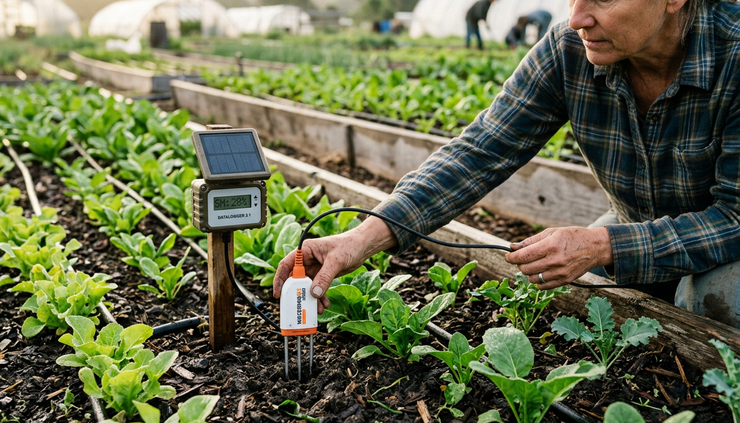
Soil sensors that track moisture, temperature, salinity, or nutrients
Drones that capture crop images from above
Satellite imagery that shows crop health across large areas
GPS-guided tractors that reduce overlaps and missed strips
Variable-rate applicators that change input amounts across a field
Automated irrigation controllers that respond to soil and weather data
This approach can reduce waste. It can also cut costs and limit environmental damage. A farmer who knows the wettest and driest parts of a field can water with more care. A grower who sees a disease patch early can treat a smaller area before it spreads.
Data analytics turns farm records into decisions
Farming has always used data, even before anyone called it that. Farmers tracked rainfall by memory, seed performance by observation, and soil condition by feel. The AI era digitises and expands that process.
A farm record system might combine:
Planting dates
Seed varieties
Fertiliser applications
Weather data
Pest reports
Labour costs
Market prices
Harvest weight
Soil test results
When these records build over several seasons, patterns emerge. Which seed performs better after late rains? Which field gives lower yields despite high fertiliser use? Which planting window reduces disease pressure? Which market gives better returns after transport costs?
AI models can process large datasets faster than a person can. They can suggest irrigation timing, predict pest risk, estimate yields, or detect crop stress from images. Still, the model is only as useful as the data behind it and the farmer’s ability to act on the advice.
Poor data can mislead. A sensor in the wrong place may not represent the field. A model trained in one region may fail in another. That is why human judgement remains central.
Sustainable farming is gaining new digital tools
The AI era is also shaped by concern for sustainability. Farmers face soil degradation, climate stress, water scarcity, biodiversity loss, and high input costs. Digital tools now support practices that reduce waste and rebuild natural systems.
Examples include:
Drip irrigation controlled by soil moisture readings
Weather-based pest alerts that reduce unnecessary spraying
Digital soil maps that guide fertiliser use
Crop monitoring that detects stress before plants wilt
Livestock tracking that supports grazing plans
Carbon and soil-health monitoring for regenerative projects
The goal is not to make farms look like laboratories. The stronger goal is to help farms use resources more carefully.
A smallholder with a mobile phone alert about fall armyworm may act earlier. A horticulture grower with drip irrigation and sensors may reduce water stress during dry spells. A dairy farmer using digital records may track feed, milk yield, breeding, and animal health more accurately.
Case studies from AI and data-led farming
Several current examples show how the AI era is taking shape.
One example is targeted spraying. Some modern sprayers use cameras and machine learning to identify weeds and spray only where needed. This can reduce herbicide use compared with blanket spraying, especially in fields where weeds are patchy. The technology fits large mechanised farms first, but the idea behind it matters widely: detect the problem before applying the solution.
Another example is drone scouting in crop production. A drone can fly over a maize, wheat, tea, or horticulture field and reveal uneven growth, water stress, pest damage, or poor drainage. The farmer or agronomist can then inspect the affected area on foot. This saves time and makes scouting more focused.
A third example is digital tractor access. In parts of Africa, platforms such as Hello Tractor have used digital booking and equipment tracking to connect tractor owners with farmers who need mechanisation services. This is not the same as a fully autonomous AI tractor, but it shows how data can solve a practical problem: matching machines to farmers at the right time.
A fourth example is soil and advisory platforms that combine soil testing, local data, and digital recommendations. Some services collect field-level information and provide guidance on crop nutrition, planting choices, or water management. These tools work best when they complement extension officers and farmer knowledge rather than replace them.
The most useful farm technology does not remove the farmer from the field. It helps the farmer notice sooner, decide better, and waste less.

Each era changed the balance between labour, knowledge, risk, and power
The shift from hand tools to AI farming is not only a change in equipment. It changes who makes decisions, who carries risk, who owns knowledge, and who benefits from production.
Traditional farming centred knowledge within families and communities. The post-modern era moved some knowledge into research stations, input suppliers, machinery firms, and government extension systems. The AI era is moving even more knowledge into data platforms, algorithms, satellite systems, and connected devices.
That shift brings both opportunity and concern.
What improved over time
Food production rose as farmers gained better seed, machinery, fertilisers, irrigation, and market access. Labour demands fell in many operations. Farmers could plant larger areas, harvest faster, and manage pests more effectively. Storage, processing, transport, and market systems improved in many regions.
AI now adds sharper timing and more precise response. It can help farmers:
Use water more carefully
Detect crop stress earlier
Reduce blanket chemical use
Match inputs to actual field needs
Record costs and yields more clearly
Prepare for weather shocks with better forecasts
For commercial growers, these tools can protect margins. For smallholders, the biggest value may come through shared services, mobile advisories, affordable sensors, local-language support, and better access to machinery or markets.
What became more difficult
Each era created new dependencies.
Traditional farming depended heavily on labour and stable local ecological knowledge. When land became scarce or climate patterns changed, old systems came under pressure.
Post-modern farming depended on fuel, fertiliser, pesticides, machinery, credit, and markets. When input prices rose, many farmers felt the strain. Environmental damage also became harder to ignore.
AI farming depends on data, connectivity, devices, technical support, and trust. A farmer needs to know who owns the data, how recommendations are made, and whether the tool works for local conditions. Poor network coverage, high device costs, and limited training can widen the gap between large farms and small farms.
The risk is clear: if AI tools only serve wealthy producers, they may increase inequality. If designed for local needs, they can help more farmers make better decisions.
The best future will mix old knowledge with new tools
The strongest farming systems will not reject tradition or worship technology. They will combine both.
Traditional practices still matter:
Saving locally adapted seed where appropriate
Using manure and compost to build organic matter
Planting cover crops and legumes
Protecting trees, terraces, and water sources
Sharing knowledge through farmer groups
Diversifying crops to reduce risk
AI tools can support those practices. Sensors can track moisture under mulch. Drones can monitor tree cover and erosion. Soil tests can guide compost and fertiliser decisions. Weather forecasts can help choose planting dates. Market data can help farmers decide when to sell.
This mix is especially relevant in places like Kenya, where agriculture ranges from small rain-fed farms to irrigated schemes, tea estates, flower farms, dairy units, pastoral systems, and urban vegetable plots. One technology will not serve all of them. A farmer in a dryland sorghum area needs different support from a greenhouse tomato grower or a rice farmer.
The future belongs to tools that fit the farm, not the other way round.
What this journey teaches about the future of food
Agriculture keeps changing because its core challenge never goes away. Farmers must produce food under pressure from weather, pests, soil limits, labour shortages, market shifts, and rising demand. Every era has offered a different answer.
Traditional agriculture teaches patience, diversity, soil care, and the value of community. The post-modern era shows the power of machines, science, irrigation, and organised supply chains. The AI era points towards farms that can measure more, waste less, and respond faster.
The most useful lesson is balance. A drone cannot replace healthy soil. A sensor cannot rebuild trust in a farming community. A tractor cannot fix poor land management. At the same time, tradition alone may not be enough for changing climate conditions, growing populations, and modern markets.
The best farms of the coming years will likely look mixed. They may use compost and satellite images, terraces and drip irrigation, farmer groups and mobile alerts, improved seed and local crop diversity. Good farming has always been about paying attention. AI simply gives farmers new ways to see.
The journey from hand tools to AI farming is still being written. Its success will depend less on the newest device and more on whether technology helps farmers protect land, earn fairly, and feed people well.


Comments